The Marketing and Sales AI Revolution
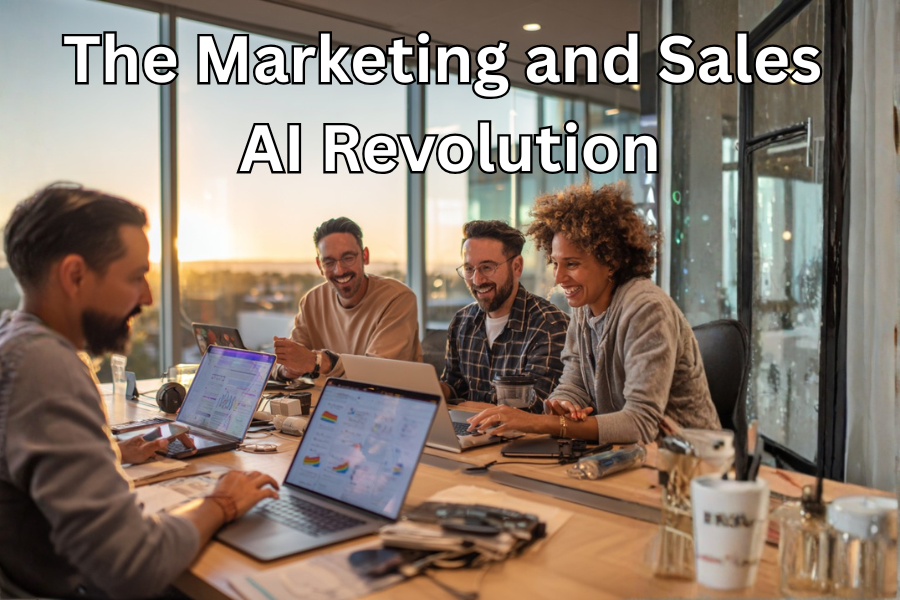
Three years ago, if you'd told me that AI would be drafting personalized outreach at scale, predicting customer churn with scary accuracy, and optimizing ad spend in real time, I would have said, "Sure, eventually." But we're not talking eventually anymore. We're talking about right now, and the gap between early adopters and everyone else is widening fast.
The difference? Early adopters aren't treating AI as a future project. They're treating it as a current competitive advantage.
What's Actually Working
Let me cut through the noise. Here's what I'm seeing work in marketing and sales AI deployments:
Hyper-personalization at scale. Your marketing team can now create genuinely personalized content for thousands of prospects—not just inserting a first name into an email template, but tailoring messaging, tone, and value propositions based on actual behavioral signals.
Predictive lead scoring that actually predicts. Forget the old points-based systems. Modern AI analyzes more than just a few signals to tell you which prospects are ready to buy. Your sales team stops chasing ghosts and starts closing deals. The ROI math is straightforward: more time on qualified leads equals more revenue per rep.
Content that doesn't take forever. AI won't write your thought leadership pieces (nor should it). But it will help you research, outline, draft first versions, optimize for SEO, and repurpose across channels. Executives are cutting content production time by 50% while increasing output quality.
Sales coaching at scale. AI can now analyze every sales call, identify what's working, and coach reps on specific techniques. It's like having your best sales trainer available 24/7 for every team member. The performance lift is measurable and sustained. This is another example of how AI can improve the performance of your existing teams. AI is not replacing it, but it’s supercharging it.
Let's Talk About What AI Can't Do
Now for some reality. Let’s be honest about the limitations.
AI doesn't understand your brand voice intuitively. It can mimic it after training, but it won't naturally know when a message feels "off-brand" or tone-deaf. That's still a human judgment call.
AI can't read the room in a client meeting. It can't pick up on subtle hesitations in a prospect's voice or on the political dynamics within a buying committee. Your best salespeople will always outperform AI in complex, relationship-driven deals.
AI makes mistakes—confidently. It will sometimes hallucinate data, misinterpret context, or make recommendations based on flawed pattern recognition. The outputs look polished, which makes the errors more dangerous, not less.
And here's the big one: AI optimizes for patterns in historical data. It's brilliant at "more of what worked before," but terrible at "what we've never tried that could be transformative." True innovation still requires human creativity, intuition, and the willingness to make bets that don't show up in the data. But AI can help you with it significantly.
The Human-AI Partnership That Wins
Here's the framework that's working: AI accelerates your work, but you remain the decision-maker.
Think of AI as your incredibly capable research assistant and first-draft generator. It can analyze competitor positioning across 50 websites in minutes. It can draft ten variations of ad copy, testing different value propositions. It can identify patterns in lost deals that your team might have missed.
But—and this is critical—you're the one who reviews, refines, and decides.
Your marketing manager should use AI to generate campaign concepts, then apply their expertise to select the winners and refine them to excellence. Your sales team should use AI insights to prioritize their pipeline, then apply their relationship skills and business acumen to close deals. Your content team should use AI to accelerate production, then add the unique perspectives and brand personality that only humans can provide.
The workflow looks like this: AI does the heavy lifting on research, analysis, and first drafts. Humans do the critical thinking on strategy, quality control, and final decisions. It's not AI replacing humans. It's AI freeing humans to do what they do best.
And here's what I'm seeing in practice: the executives who embrace this partnership are making better decisions faster. They're testing more ideas with less risk. They're scaling personalization without sacrificing quality. But they're never abdicating responsibility to the algorithm.
Why This Feels Different
I've watched enough technology waves come and go to know when something is genuinely transformative versus just well-marketed. AI in marketing and sales feels different because its value becomes apparent quickly. You're not waiting 18 months for ROI. You're seeing results in weeks.
And here's the part that excites me: we're still early. The tools are becoming more accessible, the integration is getting easier, and the use cases are expanding. Every quarter, I see new applications that make me think, "Of course—why didn't we think of that before?"
The Mindset That Wins
The executives getting this right share a common approach: they start small, measure everything, and scale what works. They're not trying to transform their entire go-to-market motion overnight. They're picking one high-value use case, proving it out, and building from there.
They're also willing to be wrong. Not every AI experiment works. But the cost of experimentation is now so low that you can afford to test, learn, and iterate quickly. The real risk isn't trying something that doesn't work—it's not trying anything at all while your competitors pull ahead.
Your Next Move
If you're reading this and thinking, "We should be doing more with AI in our marketing and sales," you're right. The question isn't whether to start—it's where.
My advice? Pick one process that's currently labor-intensive and has clear success metrics. Maybe it's a lead qualification. Maybe it's email campaign personalization. Maybe it's sales call analysis. Start there. Give it 90 days. Measure the results. Then decide whether to scale, pivot, or try something else.
But remember: you're not implementing AI to replace judgment. You're implementing AI to amplify it.
The companies that will dominate their markets in five years are the ones making these moves today. Not because they have all the answers, but because they're willing to ask the questions, run the experiments, and maintain the discipline to let AI do what it does best while humans do what they do best.
The future of marketing and sales isn't coming. It's here. The partnership between human expertise and AI capabilities is more powerful than either alone.
Value Creation with Michael
Executive advisory focused on turning M&A, AI, and transformation initiatives into measurable value — combining CFO leadership experience, 30+ transactions, and performance improvement discipline into practical executive action frameworks.
→ View Executive Advisory Engagement Options