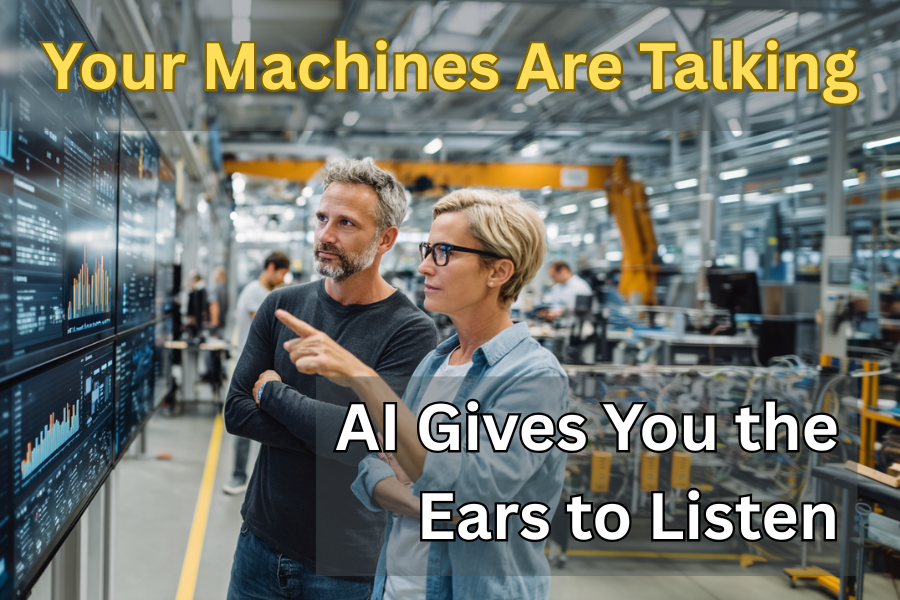
Your Machines Are Talking — AI Gives You the Ears to Listen
Here's a question that makes many operations leaders uncomfortable: How much of your maintenance budget is spent on machines that are perfectly fine, while the one that's about to fail sits there humming along, unnoticed, until it doesn't?
That's the paradox of traditional maintenance. We either fix things on a schedule (whether they need it or not) or we wait until something breaks (and then scramble). Neither approach is particularly intelligent. In 2026, "not particularly intelligent" is a choice — because AI-supported predictive maintenance has matured from a promising concept into a proven, deployable capability.
Let me walk you through what this actually looks like in practice, why it matters beyond the obvious, and where the real value shows up on your P&L.
The Shift: From Calendar-Based to Condition-Based
Most organizations still maintain their assets the way we used to change oil in our cars — every 3,000 miles, regardless of what the oil actually looked like. It's safe. It's simple. And it's expensive.
AI-supported predictive maintenance flips this model. Instead of replacing parts on a fixed schedule, sensors continuously monitor vibration, temperature, pressure, acoustic signatures, and dozens of other parameters. Machine learning models then analyze those data streams to detect patterns that precede failure — often weeks or months before a human would notice anything wrong.
The result? You intervene when the machine actually needs it. Not before. Not after. Right when it matters.
Breakdown Avoidance: The Headline Benefit Everyone Talks About
Let's start with the obvious one, because it's obvious for a reason. Unplanned downtime is brutally expensive. Depending on the industry, a single hour of unplanned production downtime can cost tens of thousands to millions of dollars. And that's before you factor in the cascading effects—missed deliveries, contractual penalties, and erosion of customer trust.
AI-driven predictive models identify failure patterns early. A bearing that's beginning to degrade produces a subtle change in vibration signature long before it seizes. A pump that's losing efficiency shows thermal anomalies weeks before it fails. The AI catches what routine inspections miss — not because your maintenance team isn't good, but because the human ear can't hear a 0.3% frequency shift in a noisy factory.
This isn't theoretical. This is happening right now across manufacturing plants, power generation facilities, fleet operations, and data centers worldwide.
Extended Machine Life: The Benefit That Doesn't Make the Headlines — But Should
Here's where the conversation gets interesting for CFOs. When you shift from time-based to condition-based maintenance, you're not just preventing breakdowns. You're reducing unnecessary interventions that actually cause wear.
Every time a technician opens a gearbox, replaces seals, or recalibrates a system that was running fine, there's a small but real risk of introducing new problems — a gasket not seated properly, a bolt torqued slightly off spec, or contamination during reassembly. Maintenance itself is a source of wear. Counterintuitive? Maybe. But ask any experienced engineer, and they'll nod.
AI lets you leave well enough alone — and act decisively when conditions genuinely warrant it. The net effect is that assets run longer, perform better, and reach the end of life later than their calendar-maintained counterparts.
That's not a maintenance improvement. That's a capital expenditure improvement. And it belongs in the boardroom conversation.
Higher Asset Reliability and More Predictable Operations
Production leaders live and die by reliability. When a critical asset goes down unexpectedly, the ripple effects are immediate: schedules are disrupted, downstream processes are starved, and quality is compromised as teams rush to recover.
Predictive maintenance doesn't just prevent failures. It stabilizes your entire operation. When you can trust that your assets will perform as expected, you can plan with confidence. Production commitments become more reliable. Service level agreements become easier to honor. And the chronic firefighting that exhausts your best people? It starts to fade.
This is one of those benefits that's hard to put a dollar figure on — until you realize that operational stability is the foundation on which everything else is built.
The Financial Case: It's Bigger Than You Think
Now let's talk money, because this is where predictive maintenance earns its seat at the strategy table.
Lower maintenance costs. Emergency repairs are expensive. Not just the parts — the overtime labor, the premium service charges, the production losses while you wait. Planned maintenance, by contrast, happens during scheduled windows at standard rates. The cost differential between an emergency repair and a planned intervention on the same equipment can easily be 3x to 5x.
Better resource planning. When your maintenance schedule is driven by predictions rather than breakdowns, your workforce planning transforms. Maintenance staff can be scheduled proactively. External service providers can be booked at standard rates with proper lead times. You stop paying rush premiums because you no longer create rush situations.
Smarter spare-parts inventory. This one is underappreciated. Traditional inventory management for maintenance parts is essentially a fear-based exercise — you stock for worst-case scenarios because you can't predict what will fail or when. Predictive maintenance changes the equation. When you know which components are trending toward failure and roughly when, you can align your inventory with predicted needs rather than paranoid assumptions. Less capital tied up in warehouse shelves. Fewer stockouts on the parts you actually need. And significantly less rush logistics — which, if you've ever expedited an industrial component on a Friday afternoon, you know is neither cheap nor fun.
More predictable budgets. Perhaps most importantly for finance leaders: predictive maintenance shifts your cost profile from volatile and reactive to planned and predictable. Emergency maintenance spend is notoriously volatile and hard to forecast, whereas planned maintenance spend is more consistent and budgetable. That's a meaningful improvement in financial planning accuracy—and it makes the CFO's job considerably easier.
The Safety Dimension
This one deserves its own section, because it's easy to overlook and critically important.
Emergency repairs are inherently more dangerous than planned ones. Technicians working under time pressure, in unexpected conditions, sometimes at odd hours — that's a recipe for incidents. When you reduce the frequency of urgent, high-pressure repair situations, you're not just saving money. You're protecting people.
I've seen organizations where the shift to predictive maintenance correlated with a measurable reduction in maintenance-related safety incidents. It makes sense when you think about it: a technician who's executing a planned procedure during a scheduled downtime window is simply in a safer position than one who's troubleshooting a sudden failure while production waits.
Operational Insight: The Compounding Benefit
Here's where predictive maintenance stops being just a maintenance initiative and becomes a strategic capability.
Every failure pattern the AI detects, every anomaly it flags, every prediction it makes — that's data. Over time, that data reveals insights you never knew about your operations. Which equipment designs are most failure-prone? Which operating conditions accelerate wear? Which maintenance procedures actually extend asset life, and which ones don't make a measurable difference?
This is the compounding benefit. The system doesn't just predict failures — it generates insights that drive continuous improvement, inform procurement decisions, and influence equipment design specifications. Organizations that treat predictive maintenance data as a strategic asset make better decisions across the board.
Upgrading Team Performance: The Human Side of AI
And here's the benefit I'm most excited about — and the one that rarely gets enough attention.
Think about your maintenance team. You probably have a handful of veterans who can diagnose problems by sound, by feel, by decades of accumulated intuition. They're invaluable. They're also retiring.
Now think about your newer technicians. Talented, motivated, but still building their experience base. In a traditional setup, it takes years — sometimes a decade or more — for a maintenance technician to develop the diagnostic instincts of a seasoned veteran.
AI-supported predictive maintenance dramatically compresses the learning curve. When the system flags an emerging issue, it doesn't just say "something's wrong." It identifies the specific pattern, points to the likely component, and often suggests the appropriate intervention. Your less experienced team members aren't guessing — they're guided. They're learning from every alert, building their understanding of failure modes and equipment behavior at an accelerated pace.
This isn't about replacing human expertise. It's about amplifying it. Your veterans become even more effective because they can focus their intuition on the edge cases the AI isn't sure about. Your newer team members become productive and confident faster because they have an AI partner that shares the collective experience encoded in years of operational data.
The result? A more capable team at every experience level. Less dependency on any single individual. And a knowledge base that grows and persists even as people move on.
Getting Started: A Practical Perspective
If you're reading this and thinking, "This sounds great, but we're not ready for this," I'd push back gently. The barrier to entry for AI-supported predictive maintenance has dropped significantly. You don't need to instrument every asset on day one. You don't need a data science team. You don't need to rip and replace your existing maintenance systems.
Start with your most critical — or most problematic — assets. Install sensors. Collect data. Let the models learn. Expand from there.
The organizations seeing the best results aren't the ones that launched the biggest projects. They're the ones that started with a focused pilot, proved the value, and scaled deliberately.
The Bottom Line
AI-supported predictive maintenance isn't a futuristic concept. It's a present-day capability that delivers measurable value across multiple dimensions — from cost reduction and asset longevity to safety improvement and team development.
The question isn't whether this technology works. It does. The question is whether you're going to be the leader who captures these benefits — or the one who explains to the board why you didn't.
Value Creation with Michael
Executive advisory focused on turning M&A, AI, and transformation initiatives into measurable value — combining CFO leadership experience, 30+ transactions, and performance improvement discipline into practical executive action frameworks.
→ View Executive Advisory Engagement Options