AI Is a Tool. So Is M&A. Neither Is a Strategy.

In every boardroom I sit in these days, the conversation eventually turns to AI. What's our AI strategy? Are we behind? What pilots are we running? Who's our AI lead?
The questions are urgent. The energy is real. And most of the time, they're the wrong questions.
I've spent 20 years on the executive side of M&A — more than 30 transactions across four continents. I've watched companies build durable advantage through acquisitions, and I've watched companies destroy enormous enterprise value by chasing deals that should never have been signed. The pattern that separates the two is almost embarrassingly simple, and it's the same pattern I now see playing out with AI:
Treating the tool as the goal is the most expensive mistake an executive can make.
The M&A Lesson Most Executives
Learn the Hard Way
Early in my career, I watched a CEO push through an acquisition because, in his words, "we need to do something." The strategic logic was thin. The integration plan was thinner. But there was a competitor making moves, a board that wanted to see action, and a calendar pressure that felt impossible to ignore.
The deal closed. The synergies didn't materialize. Two years later, the acquired business was quietly written down.
That story is not unusual. The research on M&A is brutal: a majority of deals fail to create value for the acquirer. The reason is rarely the absence of a target or a financial model. It's the absence of a strategic problem that the deal is genuinely solving.
The disciplined acquirers I've worked with all start in the same place. They don't ask, "Should we do a deal?" They ask, "What is the strategic outcome we are trying to achieve, and is M&A the right vehicle to achieve it?" Sometimes the answer is yes. Often, the answer is that organic investment, a partnership, a licensing arrangement, or doing nothing at all would create more value than a transaction.
M&A is a tool. A powerful one, when the underlying strategy is clear. A wealth-destroying one, when it isn't.
The Same Trap, Wearing New Clothes
Now look at how most companies are approaching AI.
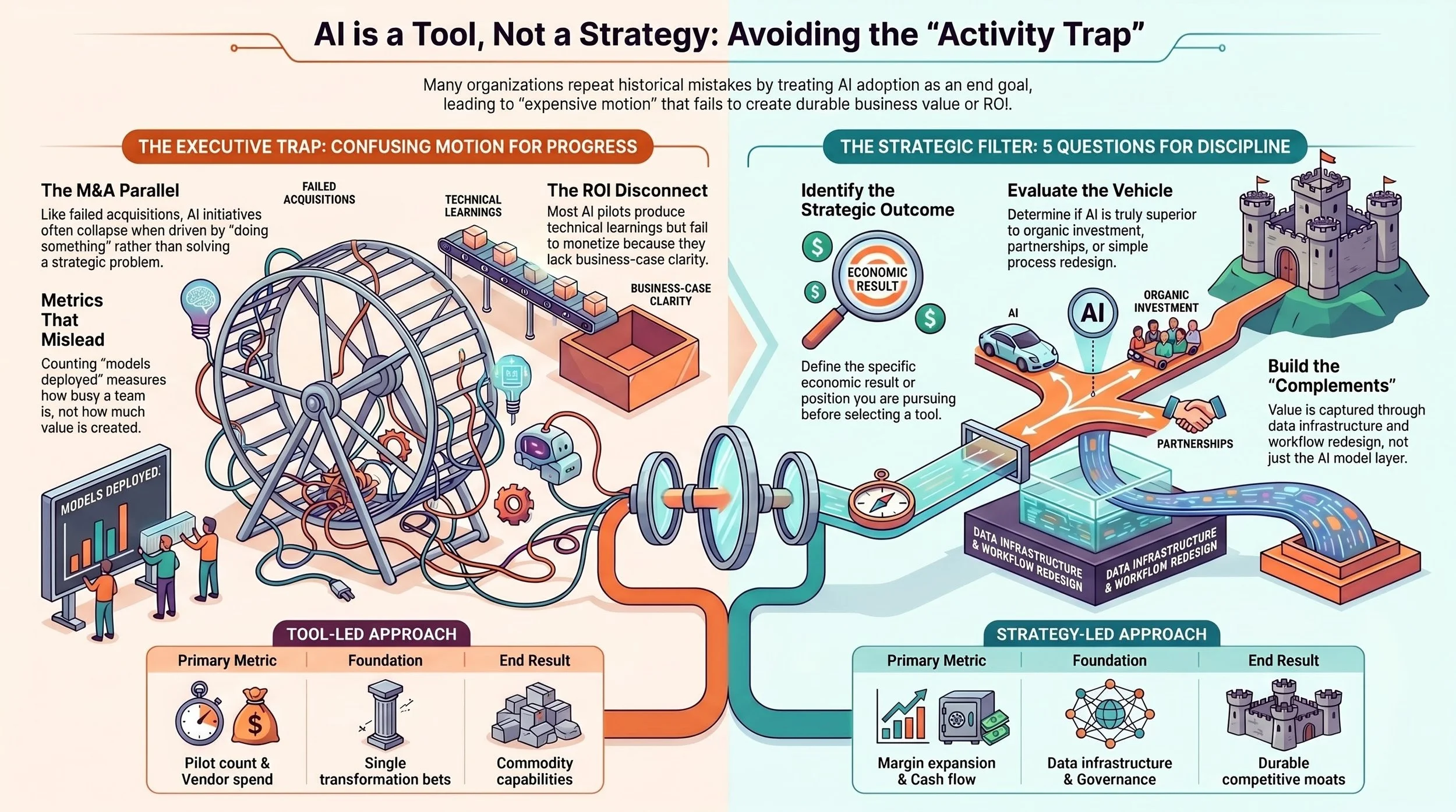
The pressure feels familiar. Boards want to see activity. Competitors are announcing initiatives. Vendors are knocking. The CEO doesn't want to be the one who "missed it." So projects get spun up. Pilots get funded. Internal AI teams get formed. Headlines get issued.
A year later, the inevitable post-mortem begins. The pilots produced learnings but few outcomes. The internal team built capabilities that nobody outside IT can monetize. The vendors got paid. And the question on the board agenda quietly shifts from "What's our AI strategy?" to "Where's the ROI?"
The mistake is the same mistake I watched companies make with M&A: confusing motion for progress, and tools for strategy.
I read a piece by Wharton's Rahul Kapoor recently that crystallized this for me. His argument, simplified: AI does not exist as a strategy in its own right. It either sharpens an existing strategic position or accumulates as an expensive activity that produces pilots, vendors, and headlines but no durable advantage. The framing struck me because it is exactly what I've been saying about M&A for two decades.
The Five Questions That Reframe Everything
Whether the tool in question is AI or an acquisition, the disciplined leader asks the same sequence of questions before approving the work:
What strategic outcome are we trying to achieve? Not "what could we do," but what specific position, capability, or economic result are we pursuing?
Is this tool the right vehicle? Compared to organic investment, partnership, process redesign, or simply executing better with what we already have, does this tool actually offer a superior path?
What complementary assets do we need to capture the value? A signed deal without integration capability destroys value. An AI deployment without data infrastructure, workflow redesign, change management, and governance does the same.
How does this compound with what we already do? The most powerful uses of either AI or M&A share infrastructure, data, customers, or capabilities across the business. Isolated initiatives drain energy. Compounding initiatives build moats.
Where will value commoditize, and where will it stick? In M&A, the question is where synergy actually lives versus where it gets competed away. In AI, it's the question of which layer of the stack — model, data, workflow, customer relationship — actually defends margin over time.
If the executive sponsoring an AI initiative cannot answer those five questions cleanly, the answer is not to launch the project. The answer is to do the strategic work first.
What This Means for CFOs and Boards
I sit at the intersection of finance and AI inside an operating company. Here is the practical implication for executives in similar positions:
Demand strategic clarity before tool selection. When a function comes to you with an AI proposal, ask them to defend the underlying strategy first — without mentioning AI. If they can't, the proposal isn't ready.
Build the complements, not just the capability. The companies that will win with AI in 2030 are the ones building data infrastructure, governance, talent, and workflow redesign now. The model layer will continue to commoditize. The complements will not.
Resist the heroic single bet. Just as serial acquirers learn through repetition and develop integration muscle, AI value creation comes from disciplined experimentation across a portfolio — not from a single transformation initiative announced on stage.
The Real Game
Generative AI is a remarkable technology. So is the modern M&A toolkit. Both can create extraordinary value in the hands of executives who are clear about why they're using them. Both can destroy enormous value in the hands of executives who treat them as the destination.
The competitive game is not played at the level of the tool. It's played at the level of strategy — and increasingly, at the level of the operating discipline that converts tools into durable advantage.
That has always been the CFO's job. It has always been the executive team's job. The arrival of AI doesn't change that. It just raises the cost of getting it wrong.
Value Creation with Michael
Executive advisory focused on turning M&A, AI, and transformation initiatives into measurable value — combining CFO leadership experience, 30+ transactions, and performance improvement discipline into practical executive action frameworks.
→ View Executive Advisory Engagement Options